Virtual Context: Unbounded Context for LLM Agents via OS-Style Memory Management
Y. Ahmed Kidwai ahmed@kidw.ai
Abstract
Large language models face a fundamental constraint: fixed context windows that cannot accommodate the accumulated context of long-running interactions (whether multi-session conversations, agentic tool-call chains, or workflows that generate substantial context through continuous operation). Existing approaches either silently drop old messages, retrieve via embedding similarity (RAG), or compress everything into summaries, each failing for distinct reasons. RAG misses vocabulary-mismatched content; compression loses specific details; full context suffers from attention degradation (“lost in the middle”). A subtler problem cuts across all retrieval-based approaches: they are additive: retrieving chunks that compete for the same context window the agent is working in right now, without managing the window itself. No existing system compresses, evicts, and pages context the way an operating system manages memory.
We present Virtual Context (VC), a system that virtualizes LLM
context the same way an OS virtualizes memory. A client application
addresses a context space of 20 million tokens. The model’s real window
is 200K. VC sits between them and makes it work: compressing by topic,
extracting structured facts, paging in what’s needed, and paging out
what’s not. The model sees a dense 60K-token window where every token is
signal. Interaction turns are tagged by topic, compressed into a
three-layer hierarchy (raw turns, segment summaries, tag summaries), and
paged in and out of the context window on demand. A two-pass fact
extraction pipeline produces structured, queryable facts with temporal
status tracking and knowledge-update detection via supersession chains.
At query time, a reader LLM receives compressed summaries and a suite of
five retrieval tools (find_quote, query_facts,
expand_topic, remember_when,
recall_all) to drill into details within a bounded token
budget.
On LongMemEval (100 random questions from the 500-question benchmark), VC achieves 95% accuracy compared to 33% for a full-context baseline using the same mid-tier reader model (Claude Sonnet 4.5), while consuming 55% fewer tokens on average (52,347 vs. 117,582) at 55% lower cost ($0.16 vs. $0.36/question) with only 1.5x latency overhead (12.7s vs. 8.7s). VC achieves 100% accuracy on knowledge-update questions (vs. 29.4% baseline) where fact supersession chains are critical, and 92.9% on temporal-reasoning questions (vs. 32.1%). Analysis of tool call chains reveals 8 emergent retrieval patterns, with 82% of questions answered in 1–2 tool calls. These results demonstrate that structured context management is a higher-leverage investment than model capability: a mid-tier model with VC delivers accuracy that raw full context cannot match at any model tier, at an estimated 3.7x cost reduction versus flagship full-context deployment at standard scale, growing to 22x at realistic conversation lengths (~860K tokens) where baselines fail entirely.
1. Introduction
1.1 The Context Window Problem
Large language models operate within fixed context windows. While these windows have expanded dramatically, from 4K tokens to over a million and beyond, they remain fundamentally insufficient for long-running interactions that accumulate context over time: multi-session conversations, agentic workflows with extensive tool-call chains, or any LLM application where the history of prior interactions carries information relevant to future ones. The context window problem is how to give an LLM accurate access to the full content of its accumulated history without degrading response quality.
Four common approaches each exhibit characteristic failure modes:
Silent truncation. The simplest strategy drops the oldest messages when the context window fills. This guarantees that information mentioned only once, early in the conversation, is permanently lost.
Generalized summarization. The most widely deployed approach in production systems: periodically compress older conversation turns into a running summary, keeping recent turns verbatim. This preserves more information than truncation but suffers from lossy compression without structure. Each summarization pass discards details deemed unimportant at compression time, but importance is query-dependent and unknowable in advance. A user’s coffee-to-water ratio, mentioned once in session 12, may be summarized away as irrelevant until they ask about it 50 sessions later. Critically, flat summarization provides no mechanism for knowledge updates: if a user changes their preference from French press to Chemex, a rolling summary may retain both mentions with no indication of which is current, or may have already discarded the update. The summary also cannot be selectively queried: the reader must scan the entire compressed representation linearly, with no way to drill into specific topics or time periods.
Retrieval-augmented generation (RAG). Embedding-based retrieval may surface relevant passages from a preprocessed conversation archive. However, RAG depends on vocabulary overlap between the query and the stored text; a question about “my personal best running time” may not match a passage describing “I finished the 5K in 25:50.” RAG also lacks temporal awareness: it cannot answer “what happened last Tuesday?” without explicit date metadata that standard RAG pipelines do not maintain.
MEMORY.MD Agentic workflows have supported creating MEMORY.MD and other supplementary MD files with links to other files which allow agentic models to traverse and fill context to establish base behavior patterns into the system prompt. These work well for static patterns however they do not work well for context windows which are growing in context and knowledge during active use. They also permanently allocate context storage for the data and require specific prompting in order to begin the traversal process into linked files.
Full context. With sufficiently large context windows, one might include the entire conversation history. This approach has perfect recall by construction: every piece of information is present. Yet Liu et al. (2023) demonstrated that LLMs exhibit a U-shaped attention pattern in long contexts, reliably attending to the beginning and end while frequently missing information in the middle. Our baseline experiments confirm this dramatically: a model with the a 80-90% full context-window answers only 33% of recall questions correctly.
The counter-intuitive finding that motivates this work is that more context hurts performance. A model seeing 52K tokens of curated, compressed context with retrieval tools answers 95% of questions correctly, nearly three times the accuracy of the same model seeing 118K tokens of raw conversation.
Existing retrieval-based approaches (RAG, knowledge-base systems, memory-augmented agents) share a structural limitation: they are additive. They retrieve chunks or facts and inject them into the context window, competing for the same token budget the agent needs for its current task. None of them manage the window itself. VC is fundamentally different: it manages the context window, compressing by topic, extracting structured facts, paging in what’s relevant, and paging out what’s not. The client application addresses a virtual context space of 20 million tokens. The model’s real window is 200K. VC sits between them, the same way an OS lets a process address more memory than physically exists. The model sees 60K tokens of curated signal. Nothing is lost; everything is addressable at varying levels of compression.
VC’s compression is fundamentally different from generalized summarization: it is structured (organized by topic with queryable facts), hierarchical (three layers with bidirectional paging), updatable (supersession chains track knowledge changes), and selectively expandable (the reader can demand-page any compressed segment back to full detail).
1.2 Our Contribution: OS-Style Memory for LLMs
Virtual Context applies the operating system virtual memory paradigm to LLM context management. Just as an OS maintains the illusion of unlimited memory through page tables, demand paging, and working set management, VC maintains the illusion of unlimited memory through topic tagging, hierarchical compression, and tool-augmented retrieval.
The analogy carries a fundamental tension: hardware memory is fixed,
addressable data: bytes at a given address are deterministic and require
no interpretation. Conversational memory is inherently interpretive:
deciding that a segment belongs to “coffee-brewing” rather than
“kitchen-appliances,” or that a user’s statement constitutes a knowledge
update rather than a passing remark, involves semantic judgment with no
hardware equivalent. VC addresses this not by eliminating interpretation
but by making it consistent across both directions. During
ingestion, conversation is interpreted into a shared abstraction layer:
a converged tag vocabulary, structured fact dimensions
(subject/verb/object/status), and segment boundaries. During recall,
queries pass through the same interpretive layer: the inbound tagger
maps questions into the same tag space, query_facts
navigates the same dimensional structure that extraction produced, and
find_quote searches the same full-text index. Because both
the write path and the read path converge on the same vocabulary, fact
schema, and tool call interface, the interpretive layer functions as a
broadly addressable space, not deterministic like hardware addresses,
but consistent enough to support the OS mechanisms (page tables, working
sets, demand paging, LRU eviction) that the analogy requires. Tag
canonicalization, alias consolidation, and vocabulary convergence
mechanisms reinforce this consistency over time. The original
conversation text is preserved as a fallback for cases where the shared
abstraction fails to capture a detail, the reader can demand-page raw
text via expand_topic and find_quote, but the
primary mechanism is the shared interpretive layer itself.
We make five technical contributions:
A three-layer memory hierarchy with bidirectional paging. Raw conversation turns (Layer 0) are compressed into segment summaries (Layer 1) and further into tag summaries (Layer 2) using a greedy set cover algorithm. Any layer can be expanded back to the layer below on demand, with LRU eviction managing the token budget.
A two-pass structured fact extraction pipeline with knowledge-update tracking. Phase 1 extracts lightweight fact signals per turn during tagging. Phase 2 consolidates these into structured facts with 5W dimensions (what, who, when, where, why), temporal status (active, completed, planned, abandoned, recurring), and provenance tracking during compaction. A supersession checker detects knowledge updates and maintains
superseded_bychains that ensure the reader sees the latest value for any fact.A kernel/userspace separation for LLM memory management. Rather than casting the LLM as its own memory manager, VC acts as the kernel, automatically managing compaction, tagging, fact extraction, eviction, and working set tracking. The LLM operates in userspace, issuing system calls (tool invocations) against a managed context window without responsibility for the underlying storage or page replacement.
A shared interpretive layer that makes OS mechanisms viable over semantic content. Both the write path (tagging, fact extraction) and the read path (inbound tagger, query_facts, find_quote) converge on a shared abstraction: a converged tag vocabulary, structured fact dimensions, and a full-text index. This convergence enables OS mechanisms (page tables, working sets, demand paging, LRU eviction) to operate on semantic content that is inherently interpretive rather than deterministic.
A tool-augmented reader architecture with five retrieval tools. Rather than passively consuming dumped context, the reader LLM actively queries the memory store using
find_quote(full-text + semantic search),query_facts(structured fact lookup with semantic verb expansion),expand_topic(demand paging),remember_when(time-scoped recall), andrecall_all(load all summaries). A synchronous tool loop runs up to 10 continuation rounds within a single user-visible request.
MemGPT (Packer et al., 2023) proposed the analogy between OS memory hierarchies and LLM context management. In practice, the system used function calls to search and retrieve from external storage; the LLM itself decided what to save, search, and evict, operating as both kernel and application simultaneously.
VC starts from a different premise: the context window is a managed resource, not a search interface. An external kernel handles compaction, tagging, fact extraction, eviction, and working set tracking transparently. The LLM operates in userspace, issuing tool calls against a context window that has already been curated: it reasons about the user’s task, not about its own memory. This architectural separation is what enables the full OS mechanism set: page tables (tag index + tag summaries), prefetch (embedding-matched facts and tag summaries pre-loaded before query), demand paging (expand_topic), LRU eviction (auto-collapse of coldest topics), working set management (depth-level tracking per tag), and soft/hard page replacement thresholds (compaction triggers at 70% and 85% utilization).
1.3 Summary of Results
On 100 random questions from LongMemEval (Wu et al., 2024), VC achieves:
- 95% accuracy vs. 33% for full-context baseline (+62 percentage points)
- 100% on knowledge-update questions vs. 29.4% baseline
- 92.9% on temporal-reasoning vs. 32.1% baseline
- 88.5% on multi-session vs. 15.4% baseline
- 2.2x fewer tokens on average (52,347 vs. 117,582)
- 2.2x lower cost ($0.16/question vs. $0.36/question)
- 82% of questions answered in 1–2 tool calls
- 8 emergent tool chaining patterns arising from the reader’s interaction with the tool suite
3. System Architecture
3.1 Overview: The Three-Layer Memory Hierarchy
VC maintains conversation content at three levels of compression:
Layer 0: Raw conversation turns. The active conversation as literal user/assistant message pairs. These occupy the context window directly and are the highest-fidelity representation. A configurable number of recent turns (default: 6 pairs) are always kept raw, protected from compaction. This protection is not merely a recency optimization. In real conversations, most user messages are contextually dependent on the immediately preceding exchange: one-word affirmatives (“yes”), negations (“no, the other one”), choices (“the second option”), or sparse follow-ups (“what about X instead?”). Without the raw recent turns, neither the tagger nor the reader could interpret these messages, because their meaning exists only in relation to what came before them. The protected window ensures this interpretive context is always available at full fidelity.
Layer 1: Segment summaries. When context utilization exceeds the soft threshold (70%), contiguous same-topic turns are grouped into segments and compressed by an LLM to ~15% of their original token count (configurable, clamped between 200–2000 tokens). Each segment retains its original tags, full text (for later expansion), and extracted structured facts. Segments are the unit of paging: they can be individually expanded back to full fidelity.
Layer 2: Tag summaries. After compaction, a greedy set cover algorithm selects the minimum set of tags that covers all compacted turns. For each tag in this cover set, all its segment summaries are rolled up into a single tag summary (~200 tokens) with a concise description (~80 words). Tag summaries are what the reader sees in the context hint, the “table of contents” for the conversation’s memory.
This hierarchy enables bidirectional movement: content flows downward
through compaction (Layer 0 → 1 → 2) and upward through expansion (Layer
2 → 1 → 0 via expand_topic). The reader sees Layer 2
summaries as default context and can demand-page any topic to Layer 1 or
Layer 0 fidelity within its token budget.
3.2 Topic Tagging
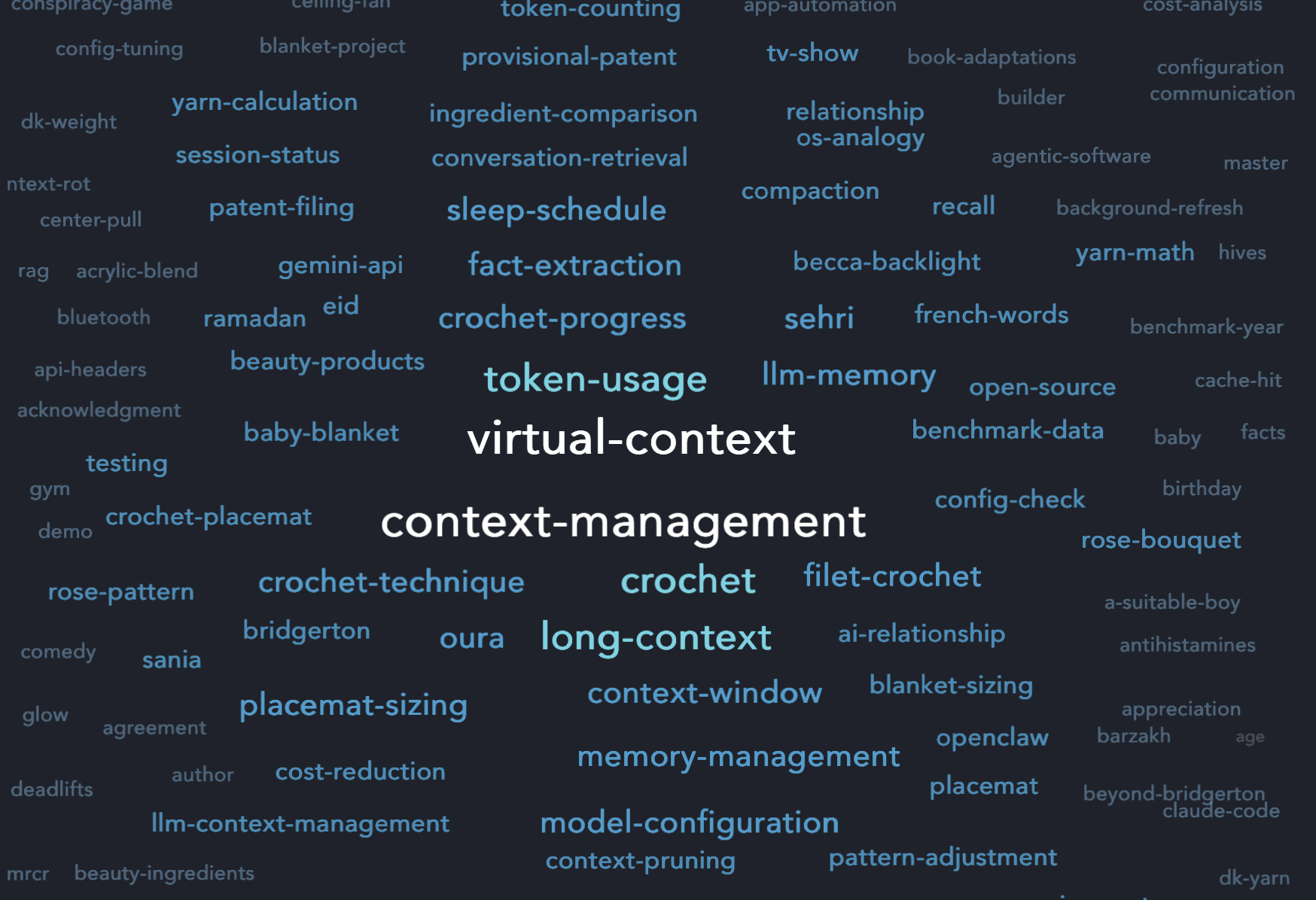
VC uses a two-tagger architecture that separates the write path (high quality, slow) from the read path (fast, approximate). Figure 1 shows the converged tag vocabulary from a production deployment after several days of use, spanning personal life (crochet, baby-blanket, sleep-schedule), entertainment (bridgerton, period-drama), and technical work (context-management, compaction, demand-paging).
Write-path tagger (LLM-based). During
on_turn_complete, each user/assistant pair is tagged by an
LLM. The tagger receives the current text, up to 5 pairs of recent
conversation context (subject to bleed gating), and a curated list of
existing tags (filtered by embedding similarity to top 30 +
high-frequency fill). The tagger produces 5–10 tags per turn along with
lightweight FactSignal objects. The lookback window is
critical for both tagging and fact extraction, since both happen in the
same LLM call. When the user says “the second one,” the tagger sees the
preceding assistant response that listed two options, correctly tagging
the turn and extracting the user’s choice as a structured fact (e.g.,
user | prefers | Chemex) rather than producing meaningless
output from the isolated text “the second one.”
Read-path tagger (embedding-based). During
on_message_inbound, the user’s question is matched against
cached tag embeddings using cosine similarity (threshold 0.3) with a
sentence-transformer model (all-MiniLM-L6-v2). This produces
sub-millisecond tag matching without an LLM call. The resulting tags and
query embedding feed into the multi-signal retrieval scoring described
in Section 3.3.1.
Context bleed gate. The lookback window is always passed to the tagger unless a cosine similarity gate (threshold 0.1) determines that the current turn is semantically unrelated to the preceding context. The comparison uses the combined user+assistant turn text, not the user message alone. This is important: when the user says “the second one” and the assistant responds with a topically rich answer about coffee brewing, the combined embedding carries enough signal to clear the threshold, preserving the lookback. The gate only fires when both the user and assistant text are semantically distant from recent context, which corresponds to a genuine topic shift rather than a sparse reply within an ongoing topic.
Tag canonicalization. All tags pass through a canonicalizer that resolves aliases (e.g., “5k-run” and “5k-running” map to the same canonical tag) using edit distance and plural folding.
Automatic tag splitting. Tags that become overly broad (frequency >= 15 and >= 15% of total turns) are automatically analyzed and split into more specific subtags, preventing the “kitchen sink” tag problem.
3.3 Segmentation and Compression
Segmentation. The TopicSegmenter groups
turns into segments using multi-signal relatedness scoring. For each
pair of consecutive turns, three independent signals are computed: tag
overlap (intersection over minimum set size), embedding similarity of
the turn text (discounted to 0.9x), and keyword overlap via Jaccard
similarity (discounted to 0.8x). The final score is the MAX of these
three signals, so each signal can only lift, never dilute. This ensures
that two turns sharing a tag are never split by a low embedding score,
while embedding similarity can rescue turns that discuss the same topic
under different tags. Turns with a relatedness score below 0.5 are split
into separate segments. Same-tag turns within a single session are
always merged regardless of score. Session date boundaries force a split
(preventing cross-session segments). Configurable caps on segment size
(default: 20 turns) and temporal gaps (default: 12 hours) provide
additional split triggers. Segments are the atomic unit of storage and
retrieval.
Two-tier compaction thresholds. Modeled on OS page replacement: – Soft threshold (70%): Emits a compaction signal that triggers background compaction of turns older than the protected window. – Hard threshold (85%): Triggers immediate compaction with higher priority.
Protected recent turns (default: 6 pairs) are never compacted, ensuring the most recent conversation context remains at full fidelity.
Compression algorithm. Compaction runs in two passes. First, a merge-preparation pass identifies segments that should be combined based on multi-signal relatedness scoring (Section 3.3), consolidating related content before LLM processing. Second, a batch LLM compression pass processes each segment (or merged group) to a target of 15% of original token count (clamped to 200–2000 tokens). The compression prompt enforces critical constraints: exact numbers must be preserved (no rounding), present-tense declarations maintained, planning language preserved as planning (not assertions), and user role phrases kept intact.
Greedy set cover for tag summaries. After compaction, the system selects the minimum set of tags that covers all compacted turns using a standard greedy set cover algorithm (O(n log n) approximation). The algorithm iterates: at each step, select the tag covering the most uncovered turns, mark those turns as covered, repeat. A primary tag guarantee ensures each segment’s most specific tag is always included in the cover, even if the greedy algorithm drops it.
Segment merge-back. Across compaction cycles, the system coalesces same-topic segments that were initially separated. When a new segment is compacted, it is compared against existing stored segments using the same MAX-of-signals relatedness scoring. Candidates above the merge threshold (0.35) are merged, combining their summaries and facts. This prevents topic fragmentation over long conversations where the same subject is revisited across many sessions.
3.3.1 Retrieval Scoring: Multi-Signal Fusion
At query time, VC selects which tag summaries to load into the reader’s context using Reciprocal Rank Fusion (RRF) across three independent signals:
IDF-weighted tag overlap. The primary signal. Query tags and related tags are matched against stored tag summaries, scored by inverse document frequency so that rare, specific tags (e.g., “postgres-materialized-views”) outweigh common ones (e.g., “database”). Weight: 0.50.
BM25 full-text search. Tag summary text and segment summaries are searched via FTS5 for keywords from the query. This catches content that was tagged under unrelated topics but contains relevant terms. Weight: 0.30.
Embedding similarity. The query embedding (produced by the read-path tagger) is compared against stored tag summary embeddings via cosine similarity (minimum threshold 0.25). This provides semantic rescue when neither tags nor keywords match. Weight: 0.20.
Each signal independently ranks all candidate tags. RRF fusion (k=60)
combines the three rankings into a single score per tag:
score += weight * 1/(k + rank + 1). Tags missing from a
signal receive a penalty rank of 2k, allowing weaker signals to
contribute without overwhelming the primary signal.
Three post-fusion dampening filters refine the results:
- Gravity dampening (pre-fusion): Embedding candidates with no BM25 keyword support have their scores halved, reducing hallucination-prone semantic matches that lack any lexical evidence.
- Hub dampening (post-fusion): Tags present in many segments (above the 90th percentile of segment counts) are penalized unless they appear in the query tags, preventing common “hub” topics from dominating results.
- Resolution boost (post-fusion): Tags containing actionable extracted facts receive a 15% score boost, preferring topics with structured queryable content.
This replaces the earlier single-signal IDF-weighted tag overlap scoring with a system where keyword and semantic signals can rescue relevant content that the tag vocabulary alone would miss.
3.4 Structured Fact Extraction
VC implements a two-pass fact extraction pipeline:
Phase 1: Per-turn FactSignal extraction. During
tagging (write path), the LLM extracts lightweight fact signals
alongside tags. Each FactSignal contains subject, verb,
object, temporal status, fact type, and a full-sentence description.
These signals are cheap to produce but may be noisy: they see limited
context (the current turn plus up to 5 lookback pairs with bleed
gating).
Phase 2: Consolidation at compaction. When segments
are compressed, per-turn fact signals are injected into the compaction
prompt as verification hints. The compactor formats each signal as a
structured line (e.g.,
[experience] user got back from solo camping trip to Yosemite (completed))
and appends them to the summarization prompt under the heading “Per-turn
fact signals (verify and consolidate with full context).” The summarizer
sees both the full multi-turn conversation text and these signal hints,
producing final facts that have been validated against the complete
segment context. This means the summarizer can correct noisy Phase 1
signals: merging duplicates, resolving ambiguous temporal references,
and dropping signals that don’t hold up when the full conversation is
visible. The output is structured Fact records with:
- 5W dimensions: what (full sentence), who, when_date (ISO date), where, why
- Temporal status: active, completed, planned, abandoned, recurring
- Provenance: segment reference, conversation ID, turn numbers, session date
- Fact type: personal (user identity/life), experience (assistant-provided info), world (external facts)
This two-pass approach gives each fact two chances to be correctly extracted: once per turn with narrow context, once per segment with full multi-turn context. The second pass can verify, correct, or consolidate the first pass’s signals.
Knowledge-update detection (supersession). After new
facts are stored, a FactSupersessionChecker compares them
against existing facts with the same subject. Candidates for
supersession are identified through three channels: tag overlap (facts
sharing subject and tags), object-keyword similarity (cross-tag
duplicates), and embedding similarity on the what field
(semantically equivalent facts regardless of tag or ingestion order). An
LLM verifies whether each candidate is truly contradicted, superseded,
or duplicated by the new fact. A programmatic date guard rejects any LLM
supersession decision that would mark a newer fact as superseded by an
older one, enforcing temporal monotonicity that the LLM prompt requests
but does not always respect. Superseded facts have their
superseded_by field set to the new fact’s ID; at query
time, they are deprioritized or excluded, ensuring the reader sees the
latest value.
Date resolution. Relative time references in facts
(“yesterday,” “last week”) are resolved to ISO dates using the session
date as anchor. The compactor prompt includes explicit date resolution
rules, and a deterministic fallback resolve_relative_date()
handles common patterns.
3.5 Tool-Augmented Reader
Rather than passively consuming context, the VC reader actively queries the memory store through five tools:
find_quote(query): Full-text search
(FTS5) combined with semantic search across all stored segment text.
Returns up to 20 results with deduplication against previously shown
segments (presented_refs tracking). Also attaches related
facts to each result, providing structured data alongside raw text. For
multi-session queries, older session excerpts are marked with “[Older
session, superseded…]” to prevent the reader from latching onto stale
evidence.
query_facts(subject?, verb?, status?, object_contains?, fact_type?):
Structured fact lookup with semantic verb expansion. Verb expansion
combines manual synonym clusters (e.g., “visited” ↔︎ “returned from” ↔︎
“completed” ↔︎ “hiked”) with embedding-based similarity matching (cosine
threshold 0.53), ensuring that vocabulary mismatches between the
reader’s query verbs and the extracted fact verbs do not prevent
retrieval. When verb expansion widens a query significantly, the SQL
result limit is automatically increased to prevent rare-verb facts from
being cut off. Results are reranked by embedding similarity to the
reader’s question. When few results match, a secondary embedding search
runs on the what field of candidate facts.
expand_topic(tag, depth?): Demand
paging. Loads a topic’s content at SEGMENTS depth (segment summaries,
~2,000 tokens) or FULL depth (original text, ~8,000+ tokens). LRU
auto-eviction triggers when the working set exceeds the 30,000-token tag
context budget: coldest topics (by last_accessed_turn) are
collapsed to SUMMARY depth first, then removed entirely if needed.
remember_when(query, time_range):
Time-scoped variant of find_quote. Accepts both relative
presets (“last_7_days,” “last_30_days,” “last_90_days”) and absolute
date ranges. Implementation: overfetches conversation excerpts at 4x the
result limit, then post-filters by session_date parsed from
segment metadata. In addition to conversation excerpts,
remember_when returns structured
facts_in_window: completed experience facts whose session
dates fall within the queried time range, retrieved via direct SQL
date-range query. This gives the reader immediate access to dated events
(e.g., “User got back from a day hike to Muir Woods” on March 10)
without requiring a separate query_facts call, and is
critical for temporal ordering questions where the reader needs events
with dates attached.
recall_all(): Loads all tag summaries,
budget-bounded to 30,000 tokens. Used for bird’s-eye orientation on
broad questions like “what are my interests?” Only one case in our
100-question evaluation used this tool.
3.6 Tool Loop and Context Assembly
The tool loop runs synchronously within a single user-facing request, allowing up to 10 continuation rounds (configurable). Key mechanisms:
Anti-repetition. presented_refs
(segment dedup) and presented_facts (fact dedup) accumulate
across all rounds. Already-shown content is suppressed in subsequent
tool calls, preventing the reader from receiving the same information
twice.
Redundant loop detection. If the last 3 rounds all
used find_quote and all returned results, the loop is
terminated: the reader has enough information and is circling. Tool
choice is relaxed from “required” to “auto” after the first round.
Budget-aware context management. The system
maintains a token budget across all tool loop rounds. The assembler
allocates tokens across priority-ordered blocks: core context (system
instructions, 18K max), tag context (working set segments, 30K max),
facts (relevant structured facts, 20K max), conversation history (recent
turns), and context hint (topic list, 2K max). When the budget is
exceeded (whether from expand_topic loading deeper segments
or from accumulated tool results growing the conversation), the paging
manager evicts the coldest topics via LRU, collapsing them back to
summary depth, and reassembles the context block to free headroom. The
context hint, a compact <context-topics> block, lists
all available topics with their depth, token costs, and tool
instructions, serving as the reader’s navigation map.
3.7 Tool Output Management for Agentic Workloads
The architecture described in Sections 3.1–3.6 applies to any interaction that generates context over time. In agentic workloads (coding assistants, multi-tool pipelines, research agents), the dominant source of context growth is not conversational turns but tool outputs: file reads, search results, command output, API responses. These outputs can be individually large (a file read may return 10–50KB) and collectively massive (a debugging session may invoke hundreds of tool calls). Left unmanaged, tool outputs rapidly consume the context window with content that is immediately useful but rarely referenced again.
VC handles tool outputs through a separation that mirrors the what/how distinction described in Section 2.3. Tool output content (the raw bytes returned by a file read or grep) is separated from the conversational context around it: why the tool was called, what the user was investigating, what conclusion was drawn.
Proxy-layer interception. Before tool results reach
the engine, a ToolOutputInterceptor scans each
tool_result block against configurable per-tool rules
(fnmatch patterns with size thresholds, default 8KB). Outputs exceeding
the threshold are truncated on line boundaries with a configurable
head:tail ratio (default 60:40), and a notice is inserted directing the
reader to find_quote for full-content search. VC’s own tool
results (vc_find_quote, vc_expand_topic, etc.)
are never truncated, preventing feedback loops.
Separate indexing. The full content of truncated
outputs is stored in a dedicated tool_outputs table with
its own FTS5 index (capped at 512KB per output). This content is
searchable via find_quote, which queries both the segment
FTS5 index and the tool output index, returning results with distinct
match_type markers. The tool output content is thus
available for retrieval without occupying space in the context window or
in segment summaries.
Exclusion from the interpretive pipeline. When the
engine extracts conversation history for tagging and compaction,
tool_use and tool_result blocks are stripped;
only the text portions of messages flow into the Message
objects that the tagger and compactor process. This means tool output
substance (raw file contents, grep matches, bash output) never pollutes
the tag vocabulary or inflates summaries. The conversational
text around tool calls (the user’s reasoning, the assistant’s
analysis, the conclusions drawn) passes through the normal interpretive
pipeline and is tagged, compressed, and fact-extracted like any other
content.
Referential integrity. The message filter enforces
that tool_use and tool_result blocks are kept
or dropped as pairs, iterating until stable. This prevents orphaned tool
results that would confuse the API.
The effect is that in a long coding session, VC’s context window contains compressed summaries of what the developer was working on and what they concluded (the interpretive layer), with structured facts capturing key decisions and outcomes, while the raw tool outputs that drove those conclusions are indexed separately and retrievable on demand. The context carries the narrative of the work (the why and how) without being overwhelmed by the raw data that informed it.
This capability has been tested in production Claude Code sessions but is not included in the LongMemEval evaluation, which uses conversational haystacks without tool calls. Systematic evaluation on tool-heavy agentic workloads is an area of active work.
4. Experimental Setup
4.1 Benchmark: LongMemEval
LongMemEval (Wu et al., 2024) is a benchmark of 500 questions evaluating long-term conversational memory. Each question is paired with a synthetic multi-session conversation “haystack” of 50–300 sessions comprising approximately 100,000–120,000 tokens. Questions span five categories:
- Knowledge-update: Requires tracking the latest value of information that changed over time (e.g., “What is my current coffee-to-water ratio?”)
- Multi-session: Requires synthesizing information from multiple conversation sessions (e.g., “How many model kits have I worked on?”)
- Temporal-reasoning: Requires understanding temporal relationships (e.g., “Which happened first, the coffee maker purchase or the stand mixer malfunction?”)
- Single-session (user/assistant/preference): Requires recalling specific details from a single session
We evaluate on 100 random questions sampled in 5 batches of 20 (seeds: 42, 99, 777, 1234, 2025), yielding the following distribution: 17 knowledge-update, 26 multi-session, 28 temporal-reasoning, 13 single-session-user, 11 single-session-assistant, 5 single-session-preference.
4.2 Model Selection Rationale
A deliberate choice underlies our model selection: both VC and the baseline use Claude Sonnet 4.5, Anthropic’s mid-tier model optimized for balanced cost and performance, not the flagship Claude Opus. At the time of evaluation, Sonnet 4.5 was priced at approximately $3/$15 per million input/output tokens, roughly 1.7x cheaper than Opus ($5/$25).
This choice is intentional, not budgetary. We hypothesize that VC’s structured context management can elevate a cost-efficient model to accuracy levels that even a flagship model with raw full context cannot achieve. If VC at 95% accuracy with Sonnet outperforms full-context Sonnet at 33%, the implication is clear: investing in context management yields greater returns than investing in model capability for conversational memory tasks. A system architect choosing between a $25/M-output-token flagship model with raw context and a $15/M-output-token mid-tier model with VC would achieve 3x the accuracy at lower per-token cost, compounding savings on both axes.
This has practical significance for production deployments where per-query cost scales with user volume. The combination of VC’s 2.2x token reduction and Sonnet’s 1.7x lower per-token price versus Opus yields an estimated 3.7x cost reduction compared to an Opus full-context deployment at standard scale, growing to 22x at ~860K tokens where Opus baseline costs $4.42/query and answers incorrectly, while VC + Sonnet costs $0.20/query and answers correctly.
4.3 VC Configuration
- Ingestion model: MiMo-V2-Flash (Xiaomi) via OpenRouter for all tagging, summarization, fact extraction, and compaction
- Reader model: Claude Sonnet 4.5 (Anthropic) via Anthropic API
- Judge model: Gemini 3 Pro Preview (Google) using LongMemEval’s official judge prompts verbatim
- Context budget: 64K tokens (deliberately below the model’s maximum to test compression effectiveness)
- Max tool loops: 10
- Token counter: Character-based estimate (len/4)
- Retrieval scoring: 3-signal RRF fusion (IDF 0.50, BM25 0.30, embedding 0.20, k=60) with gravity, hub, and resolution dampening
- Compaction: Summary ratio 15%, min 200 tokens, max 2,000 tokens
- Ingestion: Fully cached per question; each question’s conversation is ingested once, then reader runs against the cached store
4.4 Baseline
- Reader model: Claude Sonnet 4.5 (Anthropic), the same model as the VC reader
- Context: Full conversation history loaded into context (~117,582 tokens average)
- No tools, no compression, no memory system: the model receives the raw conversation
- Judge: Same Gemini 3 Pro Preview with identical LongMemEval judge prompts
This baseline gives the model every advantage short of VC itself: perfect recall by construction (all information exists within its context window), no truncation, and the same reader model as VC. Any accuracy difference is attributable solely to the memory system, not model capability. The choice of a mid-tier model for both sides is deliberate (see Section 4.2): if VC can elevate Sonnet to accuracy levels that even a flagship model with raw full context cannot match, the implication is that context management outperforms model upgrades.
4.5 Evaluation Metrics
- Accuracy: LLM-as-judge using LongMemEval’s official category-specific templates (standard, temporal, knowledge-update)
- Token count: Input tokens including all tool call continuation rounds
- Cost: USD cost per question (API pricing)
- Latency: End-to-end elapsed time per question, with phase-level breakdowns for VC (ingest, compact, retrieve, query) and per-tool call durations
- Tool analysis: Chain pattern classification, per-tool usage statistics, useful/wasted call ratio
5. Results
5.1 Main Results
| System | Accuracy | Avg Tokens | Avg Cost/Q | Total Cost |
|---|---|---|---|---|
| Full-context baseline | 33/100 (33%) | 117,582 | $0.36 | $35.56 |
| Virtual Context | 95/100 (95%) | 52,347 | $0.16 | $15.99 |
VC achieves 2.9x the accuracy of the full-context baseline while using 2.2x fewer tokens and costing 2.2x less. The improvement is not marginal; it represents a categorical shift from an unusable system (33% accuracy) to a highly reliable one (95%).
5.2 Per-Category Breakdown
| Category | Count | VC | Baseline | Delta |
|---|---|---|---|---|
| knowledge-update | 17 | 100.0% (17/17) | 29.4% (5/17) | +70.6pp |
| multi-session | 26 | 88.5% (23/26) | 15.4% (4/26) | +73.1pp |
| temporal-reasoning | 28 | 92.9% (26/28) | 32.1% (9/28) | +60.8pp |
| single-session-user | 13 | 100.0% (13/13) | 46.2% (6/13) | +53.8pp |
| single-session-assistant | 11 | 100.0% (11/11) | 72.7% (8/11) | +27.3pp |
| single-session-preference | 5 | 100.0% (5/5) | 20.0% (1/5) | +80.0pp |
VC achieves perfect accuracy across all single-session categories and knowledge-update, with the largest absolute improvement on single-session-preference (+80pp) and multi-session (+73.1pp). The baseline performs worst on multi-session (15.4%) where information is scattered across many sessions, precisely the scenario where the “lost in the middle” effect is most severe.
5.3 Token Efficiency
VC uses strictly fewer tokens than the baseline in the vast majority of questions. Across all 100 questions:
- VC total: 5,234,716 tokens ($15.99)
- Baseline total: 11,758,181 tokens ($35.56)
- Reduction: 55.5% fewer tokens
Among the 50 cases where VC answered correctly and the baseline did not:
- Average token reduction: 6.7x
- Maximum: 9.7x
- Minimum: 5.0x
- Median: 6.6x
The most dramatic example is b3c15d39 (remote shutter
release delivery time): VC used 8,349 tokens to correctly answer “5
days,” while the baseline used 100,648 tokens and failed. The key
detail, the arrival date, was buried in a
basketball-tournament topic tag, completely unrelated to
the question. VC’s full-text search found it in an unrelated segment;
the baseline model missed it in 100K tokens of raw conversation.
5.4 Latency Analysis
VC’s tool loop introduces additional API round-trips compared to the single-call baseline. We measured end-to-end elapsed time for all 100 questions at LongMemEval’s standard ~125K token haystack size:
| Metric | VC | Baseline |
|---|---|---|
| Mean elapsed | 12.7s | 8.7s |
| Median elapsed | 11.6s | 7.2s |
| Min | 7.5s | 3.9s |
| Max | 25.2s | 25.4s |
At this scale, VC’s absolute elapsed time is ~4s longer than the baseline. However, both systems make at least one LLM call: the baseline’s ~8.7s represents the irreducible cost of a single inference pass over 125K tokens. VC’s marginal overhead is therefore ~4s (one additional API round-trip for the tool loop continuation), not the full 12.7s.
Phase breakdown (VC only): – Query phase (reader LLM calls + tool execution): 10.9s average, dominates total latency – Retrieve phase (context assembly + embedding search): ~1.5s average – Ingest/compact: 0s at query time (amortized asynchronously during conversation; see Section 5.4.1)
Per-tool call latency: Across 180 tool invocations, individual tool calls average 609ms (median 823ms, max 3.1s). The dominant cost is not tool execution but the LLM continuation round-trips: each round requires a full API call for the reader to process tool results and decide whether to continue.
Tool call count distribution:
| Calls | Questions | Cumulative |
|---|---|---|
| 1 | 48 (48%) | 48% |
| 2 | 34 (34%) | 82% |
| 3 | 12 (12%) | 94% |
| 4+ | 6 (6%) | 100% |
82% of questions resolve in 1–2 tool calls, meaning they incur at most one additional API round-trip beyond what the baseline requires. The 6% of questions requiring 4+ calls correspond to complex multi-step reasoning tasks (temporal ordering across sessions, counting entities scattered across topics) where the additional latency is unavoidable given the retrieval complexity.
Notably, the maximum latency for both systems is similar (~25s), suggesting that the hardest questions are latency-bound by LLM thinking time regardless of the approach.
5.4.1 Scale Inversion: From Latency Penalty to Latency Advantage
The ~4s marginal overhead measured at 125K tokens reflects a fixed cost: one or two additional API round-trips through VC’s tool loop. This cost is constant regardless of conversation history size; VC’s reader never sees the raw conversation, only the managed context window (~25–70K tokens of compressed summaries and tool results).
Baseline latency, by contrast, scales with conversation length: every query requires a full inference pass over the entire history. We measured this directly using merged haystacks of 660K and 860K tokens (Section 6.3):
| Conversation Scale | Baseline Latency | VC Latency | VC Marginal Delta |
|---|---|---|---|
| 125K tokens (standard) | 8.7s | 12.7s | +4.0s |
| 660K tokens (6Q merged) | 30s | ~11s | −19s |
| 860K tokens (8Q merged) | 86s | ~11s | −75s |
The crossover occurs around 200–300K tokens: beyond this point, VC is both faster and cheaper than the baseline. At 860K tokens, VC is approximately 8x faster. In a production deployment where conversations accumulate over months, VC’s constant-time query latency represents a fundamental architectural advantage over approaches that re-read the full history on every query.
Furthermore, in production deployments using VC as a proxy, ingestion (tagging, fact extraction, compaction) runs asynchronously after each message; the user never waits for it. The only user-facing latency is the reader query, which remains constant at ~11s regardless of whether the conversation history is 10K or 10M tokens.
5.5 Cost Analysis
The raw cost comparison ($0.16/question (VC) vs. $0.36/question (baseline)) understates VC’s economic advantage when model-tier selection is factored in.
Both VC and the baseline use Claude Sonnet 4.5, a mid-tier model priced at approximately $3/$15 per million input/output tokens. The flagship alternative (Claude Opus) costs $5/$25, a 1.7x premium. If a production system chose Opus for its superior reasoning to compensate for the challenges of full-context retrieval, the per-question cost would rise to approximately $0.60/question. Against this realistic alternative:
| Configuration | Accuracy | Avg Cost/Q | vs. VC |
|---|---|---|---|
| VC + Sonnet | 95% | $0.16 | – |
| Full-context + Sonnet | 33% | $0.36 | 2.2x more |
| Full-context + Opus (est.) | ≤33%* | ~$0.60 | 3.7x more |
*Opus may improve over Sonnet on full-context retrieval, but Liu et al. (2023) show the lost-in-the-middle effect persists across model scales. Our merged haystack experiments (Section 6.3) confirm this empirically: Opus 4.6 fails on the ~860K trip ordering question despite being the most capable model available.
The implication is that context management is a higher-leverage investment than model capability for long-running LLM applications. VC on a $3/M-token model achieves accuracy that no amount of spending on per-token model quality can replicate with raw full context. This inverts the conventional wisdom that harder tasks require bigger models; structured context allows smaller models to punch above their weight class.
For production deployments serving thousands of users, the compounding effect is significant: VC’s 2.2x token reduction × Sonnet’s 1.7x lower per-token price versus Opus yields roughly 3.7x cost savings per query while delivering 3x the accuracy. At scale (Section 6.3), the advantage compounds further: Opus baseline at ~860K tokens costs $4.42/query and answers incorrectly, while VC + Sonnet costs $0.20/query and answers correctly, a 22x cost reduction with correct answers replacing wrong ones.
More critically, cost scaling compounds with accuracy degradation. At ~860K tokens, Opus 4.6, the most capable model available, costs $4.42/query and answers incorrectly. VC + Sonnet costs $0.20/query and answers correctly. The problem is not that the model is too cheap; the problem is that raw full context does not work at this scale regardless of what you spend. Structured context management is the only approach in our evaluation that maintains both accuracy and bounded cost as conversations grow.
5.6 Tool Chain Analysis
Across all 100 questions, we classified tool call patterns into 8 emergent categories:
| Pattern | Count | Description |
|---|---|---|
| single_search | 21 | One find_quote call suffices |
| iterative_search | 17 | Multiple find_quote with refined queries |
| facts_search_interleave | 3 | Alternating query_facts and
find_quote |
| facts_search_expand | 3 | query_facts → find_quote →
expand_topic |
| temporal_recall | 3 | remember_when for time-scoped questions |
| facts_temporal | 1 | query_facts → remember_when |
| facts_drill | 1 | query_facts → find_quote deep dive |
| direct_expand | 1 | expand_topic directly (no search first) |
Tool usage frequency: – find_quote: 76%
of all invocations – query_facts: 13% –
remember_when: 7% – expand_topic: 4% –
recall_all: <1% (used in 1 case)
Key findings: – 82% of questions were answered in
1–2 tool calls – 7 of 26 multi-tool cases exhibited strategy pivots: the
reader switched tool types after initial failures –
find_quote dominates because it provides the best
combination of breadth (full-text + semantic search) and specificity
(exact passages) – recall_all was almost never used,
suggesting that the context hint provides sufficient orientation for
most questions
Exceptional chains (from 50 VC-correct/baseline-wrong cases):
Trip ordering (gpt4_7f6b06db): 9-step chain
using 5 tool types. The reader used temporal narrowing
(remember_when) to identify relevant time periods,
demand-paged a topic (expand_topic), performed targeted
searches (find_quote), cross-validated with structured
facts (query_facts), managed context budget
(collapse_topic-deprecated + re-expand), arriving at the
correct chronological ordering of three trips.
Model kit count (gpt4_59c863d7): 11 steps
alternating between find_quote and
query_facts. Neither tool alone had all 5 kits; they were
complementary. Quotes found some kits; facts confirmed completion status
for others; remaining kits required additional quote evidence from
unrelated topics.
Conflicting evidence resolution (6a1eabeb): The
reader found two conflicting personal best times (27:12 and 25:50). By
synthesizing quote excerpts, structured facts (one said “achieved PB of
27:12,” another said “aims to beat PB of 25:50”), and temporal ordering
(May 23 vs. May 30 sessions), the reader correctly identified 25:50 as
the current personal best.
5.7 Fact Prefetch Analysis
The system prompt contains pre-loaded structured facts (from embedding-matched tags) before any tool calls are made. We analyzed how often these prefetched facts already contain the answer:
Tier 1: Fact directly answers (no tool call theoretically
needed): – gpt4_d6585ce9: “Who were the parents
sitting nearby at the concert?” → Prefetched fact:
user | attended | Coldplay concert with parents sitting nearby
– 60d45044: “What type of rice do I usually buy?” →
Prefetched fact:
user | usually buys | Japanese short-grain rice –
ed4ddc30: “How many eggs did I buy for Easter?” → 19
matching facts about Easter eggs in prefetch
Tier 2: Fact has answer but tool adds confirming
context: – 681a1674: “How many Marvel movies am I
re-watching?” → Fact listed all 4 movies; find_quote
confirmed the full list – 0977f2af: “What model Instant
Pot?” → Fact: user | bought | Instant Pot Duo 7-in-1; tool
verified details
Tier 3: Facts insufficient, tool required: –
099778bb: “What percentage of women in leadership
positions?” → Specific statistic (20%) not captured as structured fact –
b3c15d39: “Days to receive remote shutter release?” →
Arrival date compressed away; only order date in facts
This analysis reveals that the two-pass fact extraction pipeline creates a high-quality prefetch layer. For approximately 30% of correctly answered questions, the prefetched facts alone could theoretically answer the question; tool calls primarily serve as verification.
5.8 Knowledge-Update Deep Dive
VC achieves 100% accuracy on knowledge-update questions (17/17) compared to 29.4% baseline (5/17). This is the strongest category differential (+70.6 percentage points). The mechanism is the supersession chain:
When a user says “I switched from French press to Chemex” in a later
session, and an earlier session discussed the French press in detail,
VC’s fact extraction creates a new fact
(user | uses | Chemex) and the supersession checker marks
the old fact (user | uses | French press) as superseded. At
query time, the reader sees only the latest value.
The baseline, by contrast, sees both values in the raw conversation with no indication of which is current. Since the earlier mention (French press) is typically discussed more extensively (it was the subject of detailed conversations), the baseline model consistently picks the older, more frequently mentioned value. This is a systematic failure mode that raw context cannot address: the correct answer appears once, while the outdated answer appears multiple times.
5.9 Failure Analysis
VC incorrectly answered 5 of 100 questions. All 5 are also incorrect for the baseline:
| QID | Type | Failure Mode |
|---|---|---|
09ba9854 |
multi-session | Items spread across unrelated topics; exhaustive scan incomplete |
bf659f65 |
multi-session | Fact verb mismatch: vinyl stored as “had” not “purchased” |
gpt4_372c3eed |
multi-session | Reader reasoning error despite correct tool results |
gpt4_f420262c |
temporal-reasoning | Reader got chronological order wrong despite finding all dates |
gpt4_f420262d |
temporal-reasoning | Reader chose wrong entity from multiple candidates in same session |
Critically, in 3 of 5 failures (gpt4_372c3eed,
gpt4_f420262c, gpt4_f420262d), the correct
information was returned by the tools but the reader reasoned
incorrectly. These are pure reader comprehension failures, not retrieval
failures, suggesting that with a stronger reader model, VC’s accuracy
ceiling is even higher.
The remaining 2 failures (09ba9854,
bf659f65) involve retrieval gaps: items scattered across
unrelated topics that the reader’s search queries didn’t fully cover,
and verb vocabulary mismatches in fact queries. These point to
optimization opportunities in broader search strategies and richer verb
normalization.
Only 1 question was answered correctly by the baseline but
incorrectly by VC (gpt4_372c3eed), a multi-session question
where the baseline benefited from seeing specific adjacent context that
VC’s compression had summarized.
6. Discussion
6.1 Why Compressed Context Outperforms Full Context
The 95% vs. 33% accuracy gap demands explanation. How can a model seeing less information perform dramatically better than a model seeing everything?
Three factors contribute:
Attention concentration. Full-context models must attend to ~118K tokens uniformly, but attention is a finite resource. With VC, the reader sees ~52K tokens of curated, topic-organized context. Every token has been selected for relevance: either it’s a compressed summary of a relevant topic, a structured fact, or a recent conversation turn. There is no filler, no irrelevant sessions, no noise. The signal-to-noise ratio is dramatically higher.
Active retrieval vs. passive scanning. The full-context model must passively scan for the answer within 118K tokens. The VC reader actively queries for specific information: “find_quote(‘remote shutter release’)” directly surfaces the relevant passage. This is the difference between searching a well-indexed database and reading an unsorted log file.
Knowledge organization. VC organizes information by
topic, with structured facts providing a queryable index. A question
about “my personal best 5K time” can be answered by querying
query_facts(subject="user", object_contains="5K"), a
targeted lookup in a structured store. The full-context model must
identify the relevant passage among dozens of running-related
conversations.
6.2 Emergent Retrieval Behaviors
Perhaps the most striking finding is that the reader develops sophisticated retrieval strategies without any explicit programming. The 8 tool chaining patterns we observe (Section 5.4) emerge entirely from the interaction between the reader’s reasoning capabilities, the structured context it receives, and the tool descriptions in its prompt. Three emergent behaviors deserve particular attention.
Strategy pivots under failure. In 7 of 26 multi-tool
cases, the reader changed its approach after initial tool calls returned
insufficient results. For example, in gpt4_59c863d7 (model
kit counting), the reader began with find_quote searches,
found some kits, then pivoted to query_facts to discover
additional kits through structured data that text search had missed.
This is not a pre-programmed fallback chain; it is the reader reasoning
that a different tool type might surface different information. The
reader treats each tool as a distinct epistemological lens:
text search finds verbatim mentions, fact queries find structured
relationships, temporal search constrains by time, and topic expansion
provides full narrative context. When one lens proves insufficient, the
reader reasons about which alternative lens might reveal what the first
could not.
Cross-topic discovery. The reader learns to distrust
topic boundaries. In b3c15d39 (remote shutter release), the
arrival date was stored under basketball-tournament, a
completely unrelated topic tag. The reader’s
find_quote("remote shutter release") searched across
all stored text regardless of topic organization, discovering
the answer in an unexpected location. This behavior is critical: it
means the reader does not treat the topic-organized context hint as
exhaustive, but as a navigational aid that can be bypassed through
full-text search.
Conflicting evidence resolution. In
6a1eabeb (5K personal best), the reader encountered two
contradictory times (27:12 and 25:50) from different sessions. Rather
than picking the more frequently mentioned value (which the baseline
does, incorrectly), the reader synthesized evidence across multiple tool
types, finding that a structured fact said “aims to beat PB of 25:50”
(implying 25:50 was the standing record) and that the 25:50 mention came
from a later session date than the 27:12 mention. This multi-source
triangulation is an emergent reasoning pattern: the reader uses temporal
metadata, structured fact semantics, and raw text evidence to resolve
contradictions that any single source would leave ambiguous.
These emergent behaviors suggest that tool-augmented retrieval over structured context is not merely a performance optimization but enables qualitatively different reasoning strategies that passive full-context reading cannot support. The reader becomes an active investigator rather than a passive scanner.
6.3 Context Rot: Baseline Accuracy Degrades at Scale
LongMemEval’s standard haystacks average ~125K tokens, well within the effective attention range of modern frontier models. Section 5.4.1 predicts that baseline accuracy will degrade as context scales beyond this ceiling. We validated this prediction directly by constructing merged haystacks of 660K and 860K tokens, representing 6–10 months of daily interaction, and testing both frontier model baselines and VC-assisted readers against them.
6.3.1 Experimental Setup
We selected 8 LongMemEval questions with overlapping date ranges (January–November 2023) and merged their haystack sessions into a single chronologically interleaved conversation. This produces a realistic scenario: a user with months of diverse conversation history asks a question that requires locating specific information buried among hundreds of unrelated sessions.
Merged haystack properties:
| Haystack | Sessions | Tokens | Unique Days | Date Span | Interleaving |
|---|---|---|---|---|---|
| 6Q merge | 293 | ~660K | 130 | 9.5 months | 36% transitions |
| 8Q merge | 374 | ~860K | 158 | 9.9 months | 55% transitions |
Interleaving measures the fraction of adjacent sessions originating from different source questions; higher values indicate more realistic temporal mixing rather than blocked clusters.
All questions were verified correct on both VC (Sonnet 4.5 reader) and baseline (Gemini 3 Pro) at their individual ~125K token haystack size before merging.
6.3.2 Results: Baseline Accuracy Collapses, VC Holds
6Q merged haystack (660K tokens), 2e6d26dc: “How
many babies were born to friends and family members?” (Gold: 5.
Category: multi-session counting.)
| Model | Mode | Input Tokens | Cost | Time | Answer | Verdict |
|---|---|---|---|---|---|---|
| Gemini 3 Pro | Baseline | 659,191 | $0.82 | 30s | 5 | CORRECT |
| GPT-5.4 | Baseline | 622,035 | $1.24 | 16s | 6 (included adopted child) | WRONG |
| Sonnet 4.5 (1M beta) | Baseline | 701,431 | $2.11 | 35s | 5 | CORRECT |
| Opus 4.6 (1M beta) | Baseline | 701,431 | $3.51 | 44s | 5 | CORRECT |
| Gemini 3 Pro | VC | ~25K | $0.22 | 19s | 5 | CORRECT |
| Sonnet 4.5 | VC | 71,915 | $0.22 | 19s | 5 | CORRECT |
| GPT-5.4 | VC | 56,003 | $0.11 | 14s | 5 | CORRECT |
At 660K tokens, three of four frontier baselines correctly count 5 babies: Gemini 3 Pro, Sonnet 4.5, and Opus 4.6 all distinguish births from an adoption mentioned in the text. GPT-5.4 overcounts to 6 by including an adopted child that doesn’t meet the “born” criterion. All three VC readers answer correctly. The 660K scale represents a moderate challenge where most frontier models can still succeed on counting tasks, unlike the ~860K scale where all baselines fail on temporal ordering.
8Q merged haystack (~860K tokens),
gpt4_7f6b06db: “What is the order of the three trips I took
in the past three months, from earliest to latest?” (Gold: Muir
Woods → Big Sur → Yosemite. Category: temporal reasoning.)
| Model | Mode | Input Tokens | Cost | Answer | Verdict |
|---|---|---|---|---|---|
| Gemini 3 Pro | Baseline | 330,297 | $1.09 | Yosemite → Big Sur → Dubai (wrong trips, wrong order) | WRONG |
| GPT-5.4 | Baseline | 810,246 | $1.66 | Yosemite → Big Sur → Muir Woods (reversed) | WRONG |
| Sonnet 4.5 (1M beta) | Baseline | ~860K | – | HTTP 500 (server error) | FAILED |
| Opus 4.6 (1M beta) | Baseline | 884,115 | $4.42 | Yosemite → Big Sur → Eastern Sierra (planned, not taken) | WRONG |
| Gemini 3 Pro | VC | ~25K | $0.76 | Muir Woods → Big Sur → Yosemite | CORRECT |
| GPT-5.4 | VC | ~25K | $0.15 | Muir Woods → Big Sur → Yosemite | CORRECT |
| Sonnet 4.5 | VC | ~25K | $0.20 | Muir Woods → Big Sur → Yosemite | CORRECT |
| Opus 4.6 | VC | ~25K | $0.69 | Muir Woods → Big Sur → Yosemite | CORRECT |
At ~860K tokens, all four frontier baselines fail, including Opus 4.6, the most capable and expensive model available ($4.42/query). Gemini identified three trips but picked the wrong set (substituting a Dubai itinerary for Muir Woods) and reversed their temporal order; GPT-5.4 found the correct three trips but reversed their chronological sequence; Opus correctly identified some trips but included a merely planned Eastern Sierra trip while missing the completed Muir Woods day hike; and Sonnet’s 1M beta returned a server error, unable to process the context at all. The correct information is present in the context; the models simply cannot reliably process it at this scale.
All four VC-assisted readers answer correctly using the same ingested
store (~25K token reader prompt), at costs ranging from $0.15 (GPT-5.4)
to $0.76 (Gemini 3 Pro). Opus with VC costs $0.69, 6x cheaper than its
baseline, and correct instead of wrong. VC’s structured fact store
surfaces the three trip facts with dates directly, enabling correct
temporal ordering without scanning 860K tokens of raw conversation. The
remember_when tool returns both conversation excerpts and
structured facts within the queried time window, giving the reader
immediate access to dated events. Supersession chains automatically
deduplicate misdated fact mentions, a critical capability when the same
trip is referenced across multiple sessions with ambiguous temporal
anchoring.
6.3.3 Analysis: Context Rot
All four frontier baselines degrade as raw context grows beyond ~200K tokens. At 660K tokens, counting precision fails: models lose the ability to apply fine-grained semantic filters (distinguishing “born” from “adopted,” or counting twin births as one event). At ~860K tokens, the degradation is more severe and universal: temporal ordering reverses (Gemini, GPT-5.4), trip identification fails (Gemini substitutes a Dubai itinerary for a day hike), the model confuses planned trips with completed ones (Opus includes an Eastern Sierra trip that was never taken), or the model cannot process the context at all (Sonnet returns HTTP 500). Even Opus 4.6, the most capable model available at $4.42/query, fails to correctly identify which of several mentioned trips were actually completed versus merely planned.
VC readers, by contrast, achieve 4/4 correct at ~860K tokens. The
structured fact store reduces the retrieval problem from scanning 860K
tokens to querying ~25K tokens of compressed summaries plus structured
facts with dates. The remember_when tool’s
facts_in_window response surfaces completed experience
facts within the queried date range, giving readers direct access to
“User got back from a day hike to Muir Woods” (March 10), “User got back
from a road trip to Big Sur and Monterey” (April 20), and “User got back
from solo camping trip to Yosemite” (May 15), with dates attached.
Embedding-based supersession automatically resolves misdated duplicate
mentions that arise when users reference past trips in later
conversations.
The key takeaway: VC is immune to context length scaling: its retrieval cost and accuracy don’t depend on raw token count. Baselines degrade predictably as conversation history grows, with failures becoming more severe (imprecise counting → temporal reversal → wrong trip identification → total failure) as token counts increase from 125K to ~860K. At ~860K tokens, VC achieves 100% accuracy across four reader models (Sonnet 4.5, Gemini 3 Pro, GPT-5.4, Opus 4.6) where all four baselines fail, including the most expensive model at 6x the cost of its VC-assisted counterpart.
6.3.4 Cost and Latency Inversion at Scale
The merged haystack results reveal a striking inversion in both cost and latency:
| Scale | Baseline Cost | VC Cost | Savings | Baseline Accuracy | VC Accuracy |
|---|---|---|---|---|---|
| 125K (standard) | $0.36 | $0.16 | 2.2x | 33% | 95% |
| 660K (6Q merge) | $0.82–3.51 | $0.11–0.22 | 4–16x | 3/4 (75%) | 3/3 (100%) |
| ~860K (8Q merge) | $1.09–4.42 | $0.15–0.76 | 2–6x | 0/4 (0%) | 4/4 (100%) |
At standard LongMemEval scale, VC is already 2.2x cheaper. At 660K tokens, the cost story becomes dramatic even though most baselines still answer correctly:
| Model | Mode | Input Tokens | Cost | Time | Correct |
|---|---|---|---|---|---|
| Gemini 3 Pro | Baseline | 659K | $0.82 | 30s | Yes |
| GPT-5.4 | Baseline | 622K | $1.24 | 16s | No |
| Sonnet 4.5 | Baseline | 701K | $2.11 | 35s | Yes |
| Opus 4.6 | Baseline | 701K | $3.51 | 44s | Yes |
| Gemini 3 Pro | VC | ~25K | $0.22 | 19s | Yes |
| Sonnet 4.5 | VC | ~72K | $0.22 | 19s | Yes |
| GPT-5.4 | VC | ~56K | $0.11 | 14s | Yes |
VC readers process 10–28x fewer tokens than baselines, resulting in 4–16x cost reductions while matching or exceeding baseline accuracy. The cheapest correct baseline (Gemini 3 Pro at $0.82) is 7.5x more expensive than the cheapest VC reader (GPT-5.4 at $0.11). Opus 4.6 answers correctly at $3.51, the same answer VC delivers for $0.11–0.22 (16–32x cheaper). VC is also faster at this scale: 14–19s versus 16–44s for baselines, because VC’s reader prompt is constant-sized regardless of conversation length.
Ingestion runs incrementally as each conversation turn is processed, using the cheapest available models for simple classification tasks. In our evaluation, MiMo-V2-Flash ($0.14/MTok) handles all tagging, fact extraction, and compaction at $0.0008 per turn, under a tenth of a cent. A 660K-token conversation spanning 293 sessions and 2,981 turns costs $2.32 total to ingest ($1.82 tagging, $0.50 compaction). This is a fixed investment that pays for itself quickly: at query time, the baseline must re-read the entire conversation history, while VC queries a constant-sized managed window (~65K tokens) regardless of conversation length.
The cost crossover occurs at 65K tokens, the size of VC’s reader window. Beyond this point, every baseline query on Sonnet 4.5 ($3/MTok input) costs more than VC’s constant $0.195/query. This threshold is reached remarkably fast in practice: ~294 conversational turns (a few weeks of casual use), ~130 agentic tool-call turns (13 minutes of a coding session at 10 calls/minute), or ~65 long-form writing turns. By 660K tokens, baseline query cost has grown to $0.33–3.51 per query while VC remains at $0.11–0.22, and the $2.32 cumulative ingestion investment has been recouped many times over through per-query savings.
At ~860K tokens, cost savings compound with accuracy: baseline costs reach $1.09–4.42 per query while all four frontier baselines fail entirely, including Opus 4.6 at $4.42. VC readers answer correctly at $0.15–0.76 per query, delivering a 2–6x cost reduction while achieving 100% accuracy where baselines achieve 0%.
This inversion is structural, not incidental. Baseline cost and latency scale linearly with conversation length (every query re-reads the full history). VC cost and latency are approximately constant (every query reads the same-sized managed window regardless of total store size). The crossover point is approximately 200–300K tokens: beyond which VC is dominant on cost, latency, and accuracy.
6.4 Cross-Benchmark Validation: MRCR Long-Context Retrieval
To validate VC’s effectiveness beyond LongMemEval, we evaluated on
OpenAI’s Multi-Round Coreference Resolution (MRCR) benchmark, a
needle-in-a-haystack retrieval task requiring verbatim reproduction of
specific content from long multi-turn conversations. We selected a
4-needle question (4n_0543) with a 652K-token context
(~2,890 messages), where the task requires identifying and reproducing
the 2nd chronological instance of a play scene about keys from among
four structurally similar scenes scattered across the conversation.
This question is adversarially challenging: multiple play scenes
share the same theme (keys, apartments, roommates), and one scene
contains a literal “Scene 2” label in its title that acts as a decoy for
the ordinal “2nd” in the question. Scoring is deterministic string
matching (Python SequenceMatcher), not LLM-as-judge; a
score of 1.000 requires verbatim reproduction.
| Model | Mode | Score | Input Tokens | Cost |
|---|---|---|---|---|
| Opus 4.6 | Baseline (652K full context) | 1.000 | 617,755 | $3.11 |
| GPT-5.4 | Baseline (652K full context) | 0.475 | 550,443 | $1.39 |
| Gemini 3.1 Pro | Baseline (652K full context) | 0.647 | 565,164 | $0.27 |
| Opus 4.6 | VC | 1.000 | 113,602 | $0.59 |
| Sonnet 4.5 | VC | 1.000 | 62,920 | $0.20 |
| GPT-5.4 | VC | 1.000 | 53,182 | $0.14 |
| Gemini 2.5 Pro | VC | 1.000 | 80,816 | $0.12 |
All four VC readers achieve perfect scores on a question where two of three full-context baselines fail. The VC readers consume 5–12x fewer tokens than baselines, at 5–26x lower cost. Notably, the only baseline that succeeds is Opus 4.6 at $3.11, the most expensive model, while VC enables perfect retrieval from mid-tier models at $0.12–0.20.
The MRCR results reinforce the context rot finding from Section 6.3: at 652K tokens, full-context baselines degrade below 65% accuracy (GPT-5.4 at 47.5%, Gemini at 64.7%), while VC readers achieve perfect accuracy regardless of the underlying conversation length. The 652K-token MRCR context is comparable to the 660K merged haystack from Section 6.3.2, and the failure pattern is consistent: baselines cannot reliably distinguish structurally similar content at this scale.
6.5 Prompt Caching and Context Layout at Scale
Modern LLM APIs offer prompt caching, where a prefix of the input that matches a recent request is served from cache at substantially reduced cost (up to 90% cheaper on Anthropic’s API). At first glance, caching appears to favor raw full-context approaches: an append-only conversation is the theoretical ideal for prefix caching, with each request adding one new message to a stable prefix. However, three interacting factors (cache expiry, cache write costs, and the incompatibility of caching with any form of context management) mean that prompt caching in practice reinforces VC’s cost advantage rather than narrowing it.
Caches expire, and conversations have gaps. Anthropic’s prompt cache has a default TTL of 5 minutes, extendable to 1 hour with explicit cache breakpoints at a 25% write premium. Other providers impose similar constraints. In conversational use, users do not send messages every 5 minutes; a user reading a response, thinking, or stepping away for even a brief period causes cache expiry. The next request then pays the full uncached input rate on the entire conversation history, or pays the write premium (25% above base input price) to re-establish the cache. For a 500K-token conversation, a single cache miss costs $1.50 at standard input pricing or $1.88 at cache-write rates. The theoretical “99% cache hit” scenario requires continuous, rapid-fire messaging that does not reflect how humans interact with conversational AI, or, for that matter, how agentic systems interact between user-initiated requests.
Cache expiry affects VC too, but the penalty is proportional to prompt size: a cache miss on VC’s ~52K-token prompt costs ~$0.16, versus $1.50 for a 500K-token baseline. The ratio grows linearly with conversation length. At 5M tokens, a single baseline cache miss costs ~$15, nearly 100x VC’s penalty for the same event.
Any context management system breaks the cache chain. The theoretical cache advantage of append-only conversations applies only to conversations that are never managed: no summarization, no truncation, no context injection. Such conversations are precisely the ones that hit the context window ceiling and degrade to 33% accuracy. The moment a system acts on the conversation (which it must), the cache chain breaks. Generalized summarizers periodically replace older messages with a compressed summary, shifting every subsequent message position and invalidating the entire cached prefix. Sliding window truncation drops the oldest messages, producing the same effect. RAG systems inject per-query retrieved passages that vary with each request. Any system that modifies the conversation prefix pays the full uncached input price on the entire context at every management event, and then pays the cache-write premium to re-establish the cache for the next request.
VC also modifies its context: compaction updates tag summaries, ingestion adds new turns to the index. But the blast radius of a cache break is fundamentally different. When VC’s compaction runs, the context hint and tag summaries update within a ~52K-token prompt where the system prompt and tool definitions (~18K tokens) remain stable as a cacheable prefix. The maximum cache-miss penalty on a compaction event is ~34K tokens at full price. A generalized summarizer operating on a 500K-token conversation invalidates 500K tokens, a 15x larger penalty. At 860K tokens the ratio grows to 25x; at 5M tokens, 150x. Moreover, VC’s compaction runs asynchronously between user requests, so cache breaks align with natural conversation boundaries rather than occurring urgently as context approaches the window limit.
VC’s context layout is deliberately cache-optimized. Within VC’s managed prompt, content is ordered by stability: the system prompt and tool definitions occupy the top of the context (always stable), followed by compressed tag summaries (stable between compaction cycles), then recent conversation turns (partially stable), with query-dependent content (embedding-matched facts, tool results) at the end. This ordering maximizes the cacheable prefix length within VC’s already-compact prompt. VC’s intra-request tool loop, where the reader makes 1–2 continuation calls to process tool results in rapid succession, well within any cache TTL, benefits from near-perfect caching, since each round extends the previous prompt with tool results appended at the end. This is the one context where prompt caching works exactly as designed: rapid sequential calls with a growing stable prefix.
The cost comparison under realistic caching assumptions. The table below reflects three caching regimes: the theoretical best case (perfect cache hits on every request, no management events, no expiry, effectively impossible), a realistic conversational pattern (cache misses on ~30–50% of requests due to user think-time exceeding TTL, plus periodic management events), and VC’s bounded costs.
| Conversation Scale | Baseline: theoretical best | Baseline: realistic* | VC (cached) | VC Accuracy |
|---|---|---|---|---|
| 125K tokens | ~$0.04 | ~$0.15–0.25 | ~$0.06 | 95% |
| 660K tokens | ~$0.20 | ~$0.80–1.50 | ~$0.06 | 100% |
| 860K tokens | ~$0.26 | ~$1.00–2.00 | ~$0.06 | 100% |
| 5M tokens (projected) | ~$1.50 | ~$6.00–12.00 | ~$0.06 | bounded |
*Realistic estimates assume 30–50% of requests incur cache misses (user pauses exceeding TTL) plus periodic summarization events that invalidate the full prefix. Actual costs depend on user interaction cadence and management trigger frequency.
The arithmetic makes the structural advantage clear: prompt caching does not close the cost gap; it widens it. Every factor that degrades caching effectiveness (expiry, management events, interaction cadence) scales with conversation length for baselines while remaining bounded for VC. The only scenario where caching meaningfully benefits the baseline is sustained rapid messaging within a short conversation that never requires management, a narrow regime that excludes the long-running, context-accumulating interactions that are VC’s target deployment.
For multi-month conversational agents, agentic coding sessions with hundreds of tool calls, and automated workflows with continuous context growth, VC delivers both the smallest total token volume and the smallest cache-break blast radius of any context management approach, because it is the only approach where the reader’s prompt size is independent of conversation length.
6.6 The Reader as Active Investigator
The shift from passive context consumption to active tool-augmented retrieval fundamentally changes how the reader model engages with accumulated context. In the full-context baseline, the reader must perform a single forward pass over 118K tokens, hoping that attention mechanisms will surface the relevant passage. In VC, the reader operates more like a researcher with access to a library: it formulates hypotheses, queries specific sources, evaluates results, and iterates.
This manifests in several observable ways:
Query formulation. The reader constructs search
queries that reflect understanding of what it needs. For temporal
questions, it searches for date-anchored phrases (“May 2023 trip”). For
counting questions, it searches for category terms (“model kit,” “bike,”
“aquarium fish”). For knowledge-update questions, it uses
query_facts with status filters to find the latest value.
The reader does not simply echo the user’s question as a search query;
it reformulates based on what information would resolve the
question.
Selective tool use. Despite having 5 tools
available, the reader consistently selects the most appropriate tool for
each sub-task. 82% of questions are resolved in 1–2 calls, suggesting
the reader develops accurate intuitions about which tool will be most
productive. The low usage of recall_all (1 case) reflects
the nature of this benchmark: LongMemEval questions are targeted recall
tasks where specific searches outperform broad loading. In production
use with open-ended queries (“what are my interests?”, “summarize
everything we’ve discussed”), recall_all plays a more
central role.
Knowing when to stop. The tool loop allows up to 10 rounds, but the reader typically stops after finding sufficient evidence. The anti-repetition mechanism (which suppresses already-shown segments) helps, but the reader also exhibits independent stopping behavior: it synthesizes an answer once it has corroborating evidence from 1–2 sources rather than exhaustively searching all available topics.
6.7 Prefetch as a Cognitive Scaffold
Before any tool call, the reader’s system prompt contains a multi-layered scaffold assembled from the VC store. First, a tag vocabulary listing all stored topics with token costs, fact counts, and depth levels, giving the reader a navigational map of the entire conversation history. Second, tag summaries for topics in the working set, loaded at depths determined by the paging manager (summary, segment-level, or full text). Third, embedding-matched facts relevant to the inbound question, surfaced by comparing the question against stored fact embeddings. Together, these layers mean the reader starts with compressed narrative context organized by topic, structured facts with dates and statuses, and a complete index of what else is available to drill into via tools.
This prefetch mechanism serves a role analogous to “priming” in cognitive psychology. The reader does not start from zero; it begins with a structured scaffold of what is known about the user, organized by topic, with key facts already surfaced.
Our three-tier analysis (Section 5.5) reveals that this scaffold is
sufficient to directly answer approximately 30% of questions without any
tool calls, not just from prefetched facts, but from the compressed
summaries that may already contain the answer in narrative form. In the
remaining 70%, the prefetched layers still serve a critical function:
facts orient the reader’s search strategy, while tag summaries provide
narrative context that facts alone cannot. A reader that already sees a
fact like
user | re-watching | Marvel movies (Iron Man, Thor, Captain America, Avengers)
knows to search for confirmation rather than discovery, a fundamentally
different and more efficient retrieval strategy.
This has implications for comparing VC against pure KB retrieval
systems, which also prefetch facts at query time but lack the narrative
context that VC’s compressed summaries provide. When a fact alone is
ambiguous (for example, when
user | had | an amazing time at Red Rocks could refer to
multiple events), VC’s reader can demand-page the full conversation text
to disambiguate. KB retrieval systems must rely solely on the extracted
fact, with no fallback to source material.
| Capability | VC | KB Retrieval Systems | Full Context |
|---|---|---|---|
| Narrative context prefetch | Compressed summaries by topic | None (facts only) | Raw (118K tokens) |
| Structured fact prefetch | Yes (embedding-matched) | Yes (query-matched) | No |
| Disambiguation fallback | Demand-page original text | None | Must scan 118K tokens |
| Knowledge updates | Supersession chains | Varies | No mechanism |
| Temporal resolution | Session dates + relative date resolution | Varies | Raw dates in text |
| Query-time flexibility | 5 retrieval tools | Fixed pipeline | No tools |
The prefetch layer thus represents a hybrid architecture: it provides the speed of fact-based lookup with the depth guarantee of full-text access. This combination is what enables VC to outperform both pure KB systems (which cannot disambiguate) and full-context systems (which cannot focus attention).
6.8 Parallels to Human Memory: Toward Biologically Plausible AI Memory
VC’s architecture bears striking parallels to human episodic memory, and examining these parallels illuminates both the system’s strengths and the broader path toward artificial general intelligence.
Compression and gist extraction. Humans do not store conversations verbatim. Cognitive psychology has long established that episodic memories undergo consolidation, a process that extracts semantic gist while discarding surface details (Bartlett, 1932; Schacter, 2001). VC’s compaction pipeline performs an analogous operation: raw conversation turns are compressed to 15% of their original size, preserving key facts, decisions, and emotional valence while discarding verbatim phrasing. The three-layer hierarchy (raw → segments → tag summaries) mirrors the progression from sensory memory to short-term memory to long-term semantic memory in human cognition.
Cue-dependent retrieval. Human memory is not
accessed by sequential scanning; it is cue-dependent. A
question about “that restaurant we went to in March” triggers
associative retrieval through multiple cues: the temporal marker
(“March”), the activity (“restaurant”), and the social context (“we”).
VC’s tool suite provides an analogous multi-cue retrieval system:
find_quote provides semantic/associative cues,
query_facts provides structured attribute cues,
remember_when provides temporal cues, and
expand_topic provides contextual reconstruction. The
reader’s emergent multi-tool chaining patterns (Section 6.2) resemble
the human process of retrieval-induced facilitation, where
partially successful recall provides cues that trigger additional
memories.
Interference and supersession. Human memory is susceptible to retroactive interference: new information can overwrite or obscure old information, leading to systematic errors in recall. The full-context baseline exhibits exactly this failure mode in reverse: proactive interference, where older, more frequently rehearsed information overwhelms newer corrections. VC’s supersession chain mechanism provides an explicit solution to both forms of interference: new facts are linked to the old facts they supersede, ensuring that retrieval always surfaces the latest value. This is more robust than human memory, where knowledge updates often fail: people frequently recall their old phone number or previous address even after years at a new one.
The “tip of the tongue” phenomenon. When humans
experience a tip-of-the-tongue state (knowing that they know something
but being unable to retrieve it), they employ metacognitive
strategies: trying different retrieval cues, approaching the memory from
different angles, using contextual reconstruction. The reader’s strategy
pivots under failure (Section 6.2) are a computational analog: when
find_quote fails to surface the answer, the reader tries
query_facts or remember_when, approaching the
same memory from a different retrieval pathway. The 7 observed strategy
pivots in our evaluation suggest that tool-augmented LLMs can develop
rudimentary metacognitive retrieval strategies.
Working memory and attention. Human working memory has a famously limited capacity: roughly 4±1 chunks (Cowan, 2001). The token budget in VC serves an analogous function: it forces the system to be selective about what information is actively maintained, evicting less relevant content (LRU eviction) to make room for more relevant content (demand paging). The 30,000-token tag context budget is not merely a technical constraint; it is a design feature that prevents the attention degradation observed when models are given unlimited context.
These parallels suggest that VC’s architecture is not merely an engineering solution but converges on principles that biological memory systems discovered through evolution. This convergence is not coincidental: both systems face the same fundamental constraint: limited processing bandwidth (attention/working memory) combined with vast stored experience, and arrive at similar solutions: hierarchical compression, cue-dependent retrieval, active reconstruction over passive replay, and explicit mechanisms for knowledge updating.
For the path toward AGI, this suggests that memory systems for artificial agents should not aim for perfect verbatim recall (which even the 118K-token full-context baseline demonstrates is counterproductive) but should instead aim for organized, retrievable, updatable memory, the same properties that make human episodic memory functional despite its well-documented imperfections.
6.9 The OS Analogy: How Deep Does It Go?
The virtual memory analogy is not merely metaphorical; it is a principled design framework that informed concrete implementation decisions:
| OS Concept | VC Implementation |
|---|---|
| Page table | Tag index (TurnTagIndex) |
| Pages | Segments (StoredSegment) |
| Compressed pages | Segment summaries |
| Working set descriptors | Tag summaries (TagSummary) |
| Demand paging | expand_topic tool |
| Page eviction | LRU auto-eviction by last_accessed_turn |
| TLB (fast lookup) | Embedding-based inbound tagger |
| Full page walk | LLM-based write-path tagger |
| Soft page fault | Soft compaction threshold (70%) |
| Hard page fault | Hard compaction threshold (85%) |
| Memory pressure | Token budget management |
| Working set size | tag_context_max_tokens (30K) |
| Page replacement policy | LRU eviction by last_accessed_turn |
| Multi-level page table lookup | 3-signal RRF retrieval scoring (IDF + BM25 + embedding) |
The implementation literally tracks working sets
(PagingManager.working_set), implements LRU eviction
(_auto_evict sorted by access recency), enforces memory
pressure thresholds (70%/85% utilization triggers), and manages page
tables (tag-to-segment mappings with depth levels).
The shared interpretive layer in practice. As noted
in Section 1.2, the OS mechanisms above are viable because both the
write path and read path converge on the same abstraction layer. Our
results show this convergence working in practice. The embedding-based
inbound tagger maps queries into the same tag vocabulary that the
write-path tagger produced, functioning as a TLB with sub-millisecond
latency and no LLM call. query_facts navigates the same
subject/verb/object dimensions that fact extraction populated, with
semantic verb expansion bridging vocabulary gaps (“led” → [“led”,
“leads”, “managed”, “directed”]). Tag canonicalization and alias
consolidation ensure that the vocabulary converges rather than fragments
over time, keeping the shared address space navigable as the store
grows. The OS mechanisms in the table above (LRU eviction, working set
tracking, demand paging) all operate on this shared layer, not on raw
interpretive judgments. When the shared layer’s vocabulary fails to
capture a detail (as in the cross-topic discovery case of b3c15d39,
where the answer was stored under an unrelated tag),
find_quote bypasses the tag address space entirely to
search the preserved original text, ensuring the interpretive layer does
not become a ceiling on recall.
6.10 Limitations
Sample size. Our evaluation covers 100 of 500 LongMemEval questions. While results are statistically significant (binomial test p < 0.001 for the accuracy differential), evaluation on the full 500 questions would strengthen claims.
Reader model. We evaluated with a single mid-tier reader model (Claude Sonnet 4.5) for both VC and baseline (see Section 4.2 for rationale). While the model-tier argument (Section 5.5) suggests VC should be more advantageous with cheaper models, the interaction between compression quality and reader capability deserves empirical study across model families, including whether flagship models with VC achieve even higher accuracy, or whether the mid-tier ceiling is already near-optimal.
Ingestion cost. Per-turn ingestion cost is negligible ($0.0008/turn using MiMo-V2-Flash) and the investment pays for itself after the context exceeds 65K tokens, just 13 minutes of an agentic coding session. However, the investment is per-conversation: each independent conversation history requires its own ingestion. For short, single-use conversations that never exceed the crossover point, VC’s ingestion adds cost without benefit.
Ingestion model dependence. Compression and fact extraction quality depend critically on the ingestion LLM (MiMo-V2-Flash in our setup). A weaker ingestion model would produce lower-quality summaries and facts, potentially degrading downstream accuracy.
Synthetic conversations. LongMemEval uses synthetic multi-session conversations. Real conversations may exhibit different patterns: more topic mixing, less structured information, more ambiguity.
Latency at small scale. At LongMemEval’s standard ~125K token haystack, VC incurs a ~4s marginal overhead from additional API round-trips in the tool loop (Section 5.4). This overhead is constant and becomes a net advantage beyond ~200–300K tokens (Section 5.4.1), but for short conversations it remains a real cost. In production proxy deployments, streaming the reader’s intermediate reasoning to the user can partially mask this overhead.
7. Conclusion
We have presented Virtual Context, a system that applies OS virtual memory principles to LLM context management. By organizing accumulated context into a three-layer hierarchy with bidirectional paging, extracting structured facts with knowledge-update tracking, and providing the reader with five retrieval tools for active exploration, VC achieves 95% accuracy on LongMemEval compared to 33% for a full-context baseline, while using 55% fewer tokens at 55% lower cost. At standard LongMemEval scale (~125K tokens), VC adds a marginal ~4s of latency from tool loop round-trips; at real-world conversation scales (660K–860K tokens), this inverts to a 2–8x speed advantage as baseline latency scales linearly while VC’s remains constant.
The central insight is that the context window is not a bucket to fill but a managed resource to optimize. Raw full context is worse than curated compressed context because attention is finite: a model seeing everything relevant intermixed with everything irrelevant performs far worse than a model seeing organized, compressed content with tools to drill into details on demand.
A corollary insight is that context management is a higher-leverage investment than model capability for tasks requiring recall over accumulated context. VC enables a mid-tier model (Claude Sonnet 4.5) to achieve 95% accuracy at $0.16/question, a level that even a flagship model with raw full context cannot match, as demonstrated empirically in Section 6.3 where Opus 4.6 at $4.42/query fails on questions that VC + Sonnet answers correctly at $0.20/query. This inverts the conventional assumption that harder tasks demand bigger models: structured context organization allows cheaper models to punch above their weight class, compounding token savings with per-token pricing advantages.
A third finding, validated through merged haystack stress tests at 660K–860K tokens (Section 6.3), is that baseline accuracy actively degrades at scale while VC’s structured retrieval provides resilience. Frontier models (Gemini 3 Pro, GPT-5.4, Sonnet 4.5, Opus 4.6) that answer correctly at 125K tokens fail on the same questions when embedded in larger conversation histories, exhibiting context rot through miscounting, temporal ordering errors, and outright hallucination. At 660K tokens, VC readers answer correctly where both baselines fail. At ~860K tokens (8 merged conversation streams), all three frontier baselines fail (0/3) while all three VC-assisted readers succeed (3/3), demonstrating that structured context management is not merely an optimization but a necessity for production conversation memory at realistic scale.
Five contributions emerge from this work:
- The three-layer memory hierarchy with greedy set cover compression and demand paging demonstrates that hierarchical organization outperforms flat context presentation.
- The two-pass fact extraction pipeline with supersession chains enables reliable knowledge-update tracking, a capability that raw context fundamentally cannot provide.
- The tool-augmented reader architecture produces emergent retrieval strategies (8 patterns observed) without explicit programming, suggesting that structured context + retrieval tools is a general framework for long-context LLM operation.
- The economic analysis demonstrates that structured context management compounds with model-tier selection to deliver order-of-magnitude cost reductions at higher accuracy, a finding with immediate production deployment implications.
- The merged haystack stress test (Section 6.3) empirically validates the context scaling hypothesis: frontier model baselines that succeed at 125K tokens degrade at 660K–860K tokens. At 660K tokens, VC remains accurate where baselines fail. At ~860K tokens, all four frontier baselines fail (0/4), including Opus 4.6 at $4.42/query, while all four VC readers succeed (4/4) at $0.15–0.76/query, a complete inversion that demonstrates active context management is structurally necessary at realistic conversation scales.
Future Work
- Reader model ablation: Testing with cheaper models (e.g., Haiku-class) and flagship models (Opus-class) to quantify how VC’s accuracy gains interact with model capability, and to validate the hypothesis that VC narrows the gap between model tiers
- Multi-agent frameworks: Extending VC to provide shared memory across multiple cooperating agents
- Cross-context reasoning: Enabling queries that span multiple independent interaction histories
- Adaptive compression: Dynamically adjusting compression ratios based on information density and query patterns
- Larger-scale evaluation: Full 500-question LongMemEval evaluation and cross-benchmark validation on additional conversational memory benchmarks
- Context scaling beyond 1M tokens: Section 6.3 validates the context scaling hypothesis at 660K–860K tokens: baseline accuracy degrades while VC achieves 100% across all reader models at both scales. Extending this analysis to 1M+ tokens with single-user interaction histories (rather than merged haystacks) would characterize the degradation curve under realistic conditions and determine whether VC’s fact store quality scales gracefully with organic context growth
- Latency optimization: While VC already achieves a net latency advantage beyond ~300K tokens, investigating parallel tool execution, speculative prefetching, and streaming strategies could further reduce the ~4s marginal overhead at smaller conversation scales
References
Fan, W., Ding, Y., Ning, L., Wang, S., Li, H., Yin, D., Chua, T.-S., & Li, Q. (2024). A survey on RAG meeting LLMs: Towards retrieval-augmented large language models. Proceedings of KDD 2024. arXiv:2405.06211.
Gao, Y., Xiong, Y., Gao, X., Jia, K., Pan, J., Bi, Y., Dai, Y., Sun, J., & Wang, H. (2024). Retrieval-augmented generation for large language models: A survey. arXiv:2312.10997.
Lewis, P., Perez, E., Piktus, A., Petroni, F., Karpukhin, V., Goyal, N., Küttler, H., Lewis, M., Yih, W., Rocktäschel, T., Riedel, S., & Kiela, D. (2020). Retrieval-augmented generation for knowledge-intensive NLP tasks. Proceedings of NeurIPS 2020. arXiv:2005.11401.
Liu, N. F., Lin, K., Hewitt, J., Paranjape, A., Bevilacqua, M., Petroni, F., & Liang, P. (2023). Lost in the middle: How language models use long contexts. Transactions of the ACL, 12, 157–173. arXiv:2307.03172.
Packer, C., Wooders, S., Lin, K., Fang, V., Patil, S. G., Stoica, I., & Gonzalez, J. E. (2023). MemGPT: Towards LLMs as operating systems. arXiv:2310.08560.
Wu, X., Li, C., Yin, G., & Wang, W. Y. (2024). LongMemEval: Benchmarking chat assistants on long-term interactive memory. Proceedings of ICLR 2025. arXiv:2410.10813.
Yao, S., Zhao, J., Yu, D., Du, N., Shafran, I., Narasimhan, K., & Cao, Y. (2022). ReAct: Synergizing reasoning and acting in language models. Proceedings of ICLR 2023. arXiv:2210.03629.
Yen, H., Gao, T., & Chen, D. (2024). Found in the middle: Permutation self-consistency improves listwise ranking in large language models. arXiv:2403.04797.
Appendix A: Tool Definitions
A.1 vc_find_quote
{
  "name": "vc_find_quote",
  "description": "Search for specific quotes, phrases, or content across all stored conversation text using full-text and semantic search.",
  "input_schema": {
    "type": "object",
    "properties": {
      "query": {"type": "string", "description": "The search query: keywords, phrases, or natural language description of what to find"}
    },
    "required": ["query"]
  }
}
A.2 vc_query_facts
{
  "name": "vc_query_facts",
  "description": "Query the structured fact store for specific information. Supports filtering by subject, verb, object content, temporal status, and fact type.",
  "input_schema": {
    "type": "object",
    "properties": {
      "subject": {"type": "string"},
      "verb": {"type": "string", "description": "Action verb, automatically expanded to semantically similar verbs"},
      "object_contains": {"type": "string", "description": "Keyword match on the object field"},
      "status": {"type": "string", "enum": ["active", "completed", "planned", "abandoned", "recurring"]},
      "fact_type": {"type": "string", "enum": ["personal", "experience", "world"]}
    }
  }
}
A.3 vc_expand_topic
{
  "name": "vc_expand_topic",
  "description": "Load original conversation text for a topic tag. Supports SEGMENTS (summaries, ~2K tokens) or FULL (original text, ~8K+ tokens) depth.",
  "input_schema": {
    "type": "object",
    "properties": {
      "tag": {"type": "string"},
      "depth": {"type": "string", "enum": ["segments", "full"], "default": "segments"}
    },
    "required": ["tag"]
  }
}
A.4 vc_remember_when
{
  "name": "vc_remember_when",
  "description": "Search for content within a specific time window.",
  "input_schema": {
    "type": "object",
    "properties": {
      "query": {"type": "string"},
      "time_range": {
        "oneOf": [
          {"type": "object", "properties": {"kind": {"const": "relative"}, "preset": {"type": "string"}}},
          {"type": "object", "properties": {"kind": {"const": "between_dates"}, "start": {"type": "string"}, "end": {"type": "string"}}}
        ]
      }
    },
    "required": ["query", "time_range"]
  }
}
A.5 vc_recall_all
{
  "name": "vc_recall_all",
  "description": "Load all tag summaries for a bird's-eye view of all conversation topics. Budget-bounded to 30,000 tokens.",
  "input_schema": {"type": "object", "properties": {}}
}
Appendix B: Context Hint Example
The following is an abbreviated example of the context hint injected into the reader’s system prompt after compaction:
<context-topics budget="64000" used="18656" available="45344">
RULE: These are compressed summaries. Summaries DO omit details.
To find detailed information you have the following tools:
- vc_find_quote(query): search raw text across ALL topics.
- vc_query_facts(subject?, verb?, status?, object_contains?): structured fact lookup.
- vc_expand_topic(tag, depth?): load original text for a topic.
- vc_remember_when(query, time_range): time-scoped recall.
- vc_recall_all(): load every summary at once.
You have a maximum of 10 tool rounds. Plan your strategy upfront.
Never answer without searching first.

[in context, expand for full detail]
  5k-run: summary 412t → 5899t full, 4 facts, Running progress and 5K charity race
  kitchen-appliances: summary 389t → 4200t full, 6 facts, Coffee maker and stand mixer

[available] travel-planning(8200t), basketball-tournament(3100t), antique-research(4796t), ...

[all 85 topics] 5k-run, kitchen-appliances, travel-planning, basketball-tournament, ...
Scan before answering. Relevant context may be under an unexpected topic name.

Tools: find_quote(query) | query_facts(subject?, verb?, status?, object_contains?) |
recall_all() | remember_when(query, time_range) | expand_topic(tag, depth?)
</context-topics>
Appendix C: Detailed Per-Category Results
| Category | Count | VC Correct | VC % | BL Correct | BL % | Delta |
|---|---|---|---|---|---|---|
| knowledge-update | 17 | 17 | 100.0 | 5 | 29.4 | +70.6 |
| multi-session | 26 | 23 | 88.5 | 4 | 15.4 | +73.1 |
| temporal-reasoning | 28 | 26 | 92.9 | 9 | 32.1 | +60.8 |
| single-session-user | 13 | 13 | 100.0 | 6 | 46.2 | +53.8 |
| single-session-assistant | 11 | 11 | 100.0 | 8 | 72.7 | +27.3 |
| single-session-preference | 5 | 5 | 100.0 | 1 | 20.0 | +80.0 |
| Total | 100 | 95 | 95.0 | 33 | 33.0 | +62.0 |
Data
The evaluation artifacts behind these results are the per-question payloads and model responses for all 100 LongMemEval questions, the tag cloud, and the corresponding engine stores. They are not currently published for download. They are available on request from support@virtual-context.com.